Self-Employed Deduction vs Premium Tax Credit
Self-Employed Health Insurance Deduction vs. Premium Tax Credit: What's the Difference?
These are the two big tax breaks for people who buy their own health insurance, and they get confused constantly, because both "lower what you pay." They work in completely different ways, apply to different plans, and in 2026 the difference matters more than ever. Here is the clean breakdown.
The 30-second version
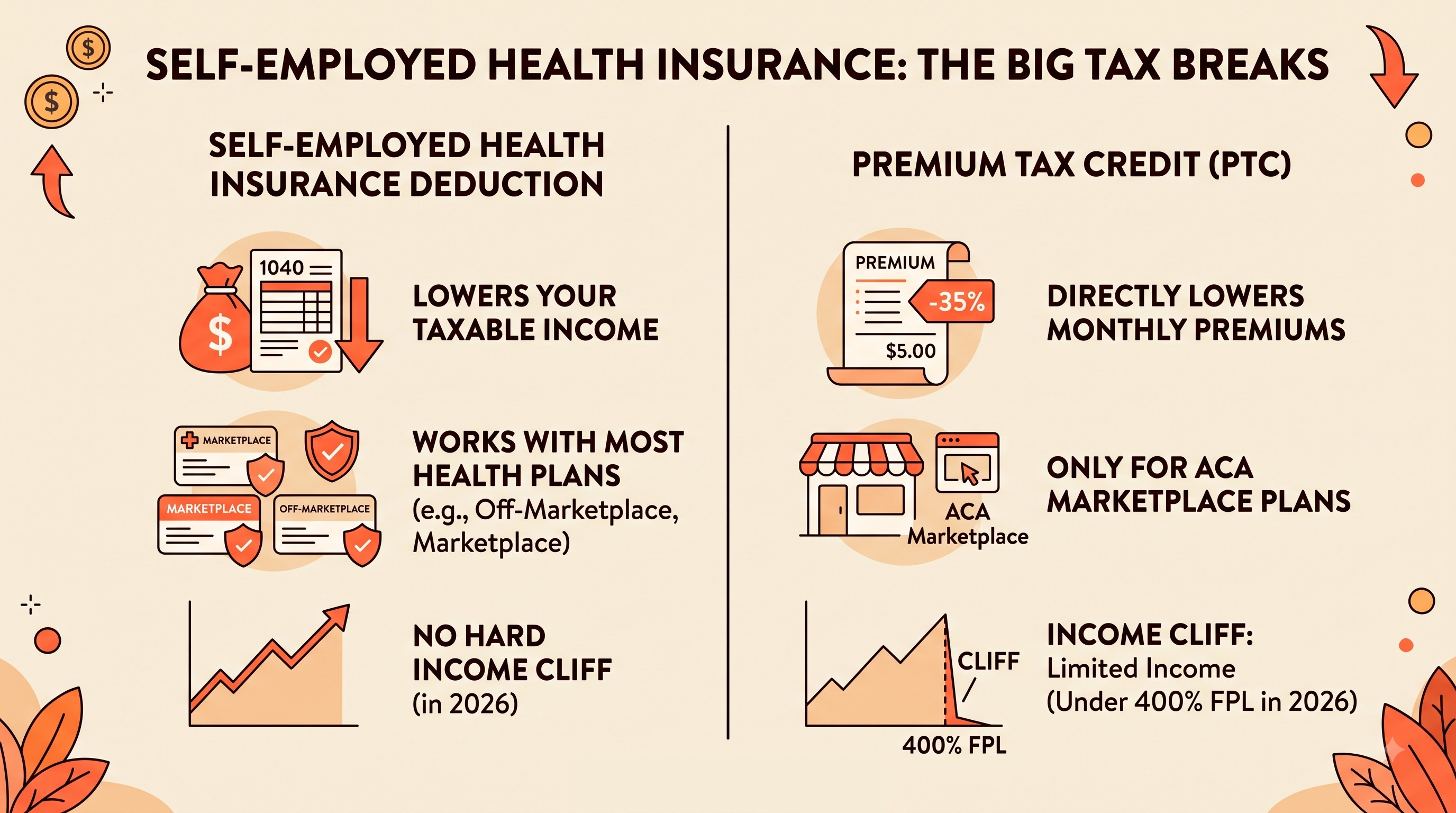
- The self-employed health insurance deduction lowers your taxable income. It works with almost any qualifying health plan, bought anywhere, including off-marketplace plans.
- The premium tax credit (PTC) directly lowers your monthly premium, but only for plans bought on the ACA marketplace, and only if your income is under the limit, which is back to a hard 400% of poverty cutoff in 2026.
- You can qualify for both in the same year, but never on the same premium dollars. No double-dipping.
The self-employed health insurance deduction
What it is: an above-the-line deduction (you get it even without itemizing) for health, dental, and qualified long-term-care premiums covering you, your spouse, your dependents, and children under 27. It is claimed via IRS Form 7206 and flows to Schedule 1 of your 1040.
Who qualifies: you need self-employment income (sole proprietor, 1099 contractor, partner, or more-than-2% S-corp shareholder with premiums run through wages), and the deduction is capped at your net self-employment profit. The catch most people miss: you cannot take it for any month you were eligible for an employer-subsidized plan, yours or your spouse's, even if you did not enroll.
What it is worth: your premiums times your marginal tax rate. A freelancer paying $7,200 a year in premiums in the 24% bracket saves about $1,728 in federal income tax.
The key feature for 2026: the deduction does not care where you bought the plan or how much you earn. Marketplace plan, off-marketplace plan like Molli, no income cliff. If you are a high earner who lost subsidy eligibility this year, this deduction is the tax break you still control.
The premium tax credit
What it is: a credit that pays part of your monthly premium directly (or reconciles on your return via Form 8962). Its size is the gap between the benchmark Silver premium and a set percentage of your household income.
Who qualifies in 2026: only people who buy through the ACA marketplace (HealthCare.gov or a state exchange) with household income between 100% and 400% of the federal poverty level. The enhanced pandemic-era credits expired December 31, 2025, so above 400% FPL (about $62,600 for a single person) the credit is now zero. We covered the mechanics in our subsidy cliff breakdown.
The reconciliation trap: the credit is based on your estimated income. Self-employment income swings, and if you earn more than you estimated, you can owe credits back at tax time. In a cliff year, crossing the 400% line retroactively can mean paying back the entire year's credit.
How they interact
If you have a marketplace plan with a premium tax credit, you can only deduct the share of premiums you actually paid, not the share the credit covered. (The IRS has an iterative calculation for this because the deduction changes your income, which changes your credit. Tax software handles it; this is firmly "get a professional" territory.)
If you have an off-marketplace plan, it is simpler: no credit exists, so the full premium you pay is potentially deductible.
Which one applies to you
| Your situation (2026) | Premium tax credit | SE health insurance deduction |
|---|---|---|
| Marketplace plan, income under 400% FPL | Yes | Yes, on the share you pay yourself |
| Marketplace plan, income over 400% FPL | No (cliff) | Yes |
| Off-marketplace plan (like Molli), any income | No, never applies | Yes, on the full premium |
| Any month you could join an employer or spouse's plan | Credit rules differ | No, for those months |
Where Molli fits
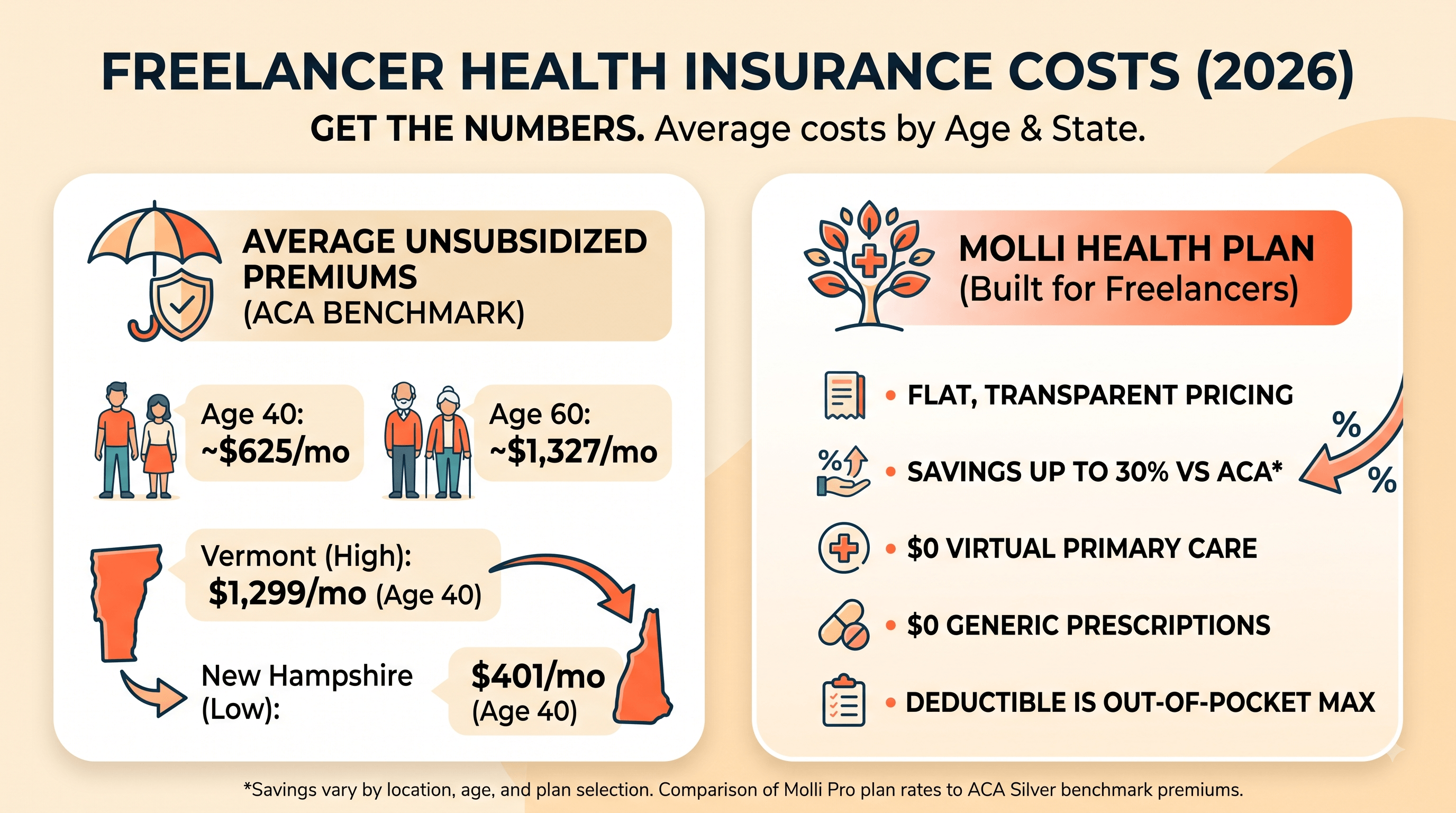
Molli is an ACA-compliant major medical plan for 1099 and self-employed workers, sold off the marketplace. That means the premium tax credit never applies to it, and Molli's pricing is built accordingly: flat, transparent rates that can save up to 30% vs. ACA marketplace plans¹, with no estimate-your-income guesswork and no reconciliation surprises at tax time. Premiums for a plan like Molli are generally eligible for the self-employed health insurance deduction, subject to the rules above.
If you lost your subsidy to the cliff this year, compare your full unsubsidized marketplace price against Molli's rates, and take the deduction either way.
This article is general information, not tax advice. Confirm your specific situation with a tax professional.
Frequently asked questions
Can I take the self-employed health insurance deduction for an off-marketplace plan? Generally yes. The deduction is not limited to marketplace plans; it applies to qualifying health premiums you pay yourself, including off-marketplace plans like Molli, capped at your net self-employment profit.
Can I get the premium tax credit for a plan bought off the marketplace? No. The premium tax credit only applies to plans purchased through the ACA marketplace, and in 2026 only if household income is between 100% and 400% of the federal poverty level.
Can I use both the deduction and the credit? In the same year, yes, but not on the same premium dollars. With a subsidized marketplace plan you deduct only the share you actually paid. With an off-marketplace plan there is no credit, so the full premium you pay is potentially deductible.
Which is worth more? For income under 400% FPL, the credit is usually worth more because it pays premiums directly. Above the 2026 cliff, the credit is zero, and the deduction is the main tax break left, worth your premiums times your marginal rate.
¹ Savings vary by location, age, and plan selection. Based on comparison of Molli Pro plan rates to ACA Silver benchmark premiums.