What Is Minimum Essential Coverage
What Is Minimum Essential Coverage (MEC), and Why Does It Matter?
"Minimum essential coverage" sounds like bureaucratic filler, but it is the single most useful phrase for telling real health insurance apart from products that just look like it. Here is what it means, what qualifies, and why you should check for it before buying any plan in 2026.
The definition
Minimum essential coverage (MEC) is the Affordable Care Act's term for health coverage that satisfies the law's coverage requirement. It is the ACA's dividing line: plans on the MEC list are treated as real health coverage under federal law; everything else is not.
The concept was created for the individual mandate, and it still anchors how coverage is classified, reported to the IRS, and treated by state law.
What counts as MEC
Per CMS and IRS guidance, minimum essential coverage includes:
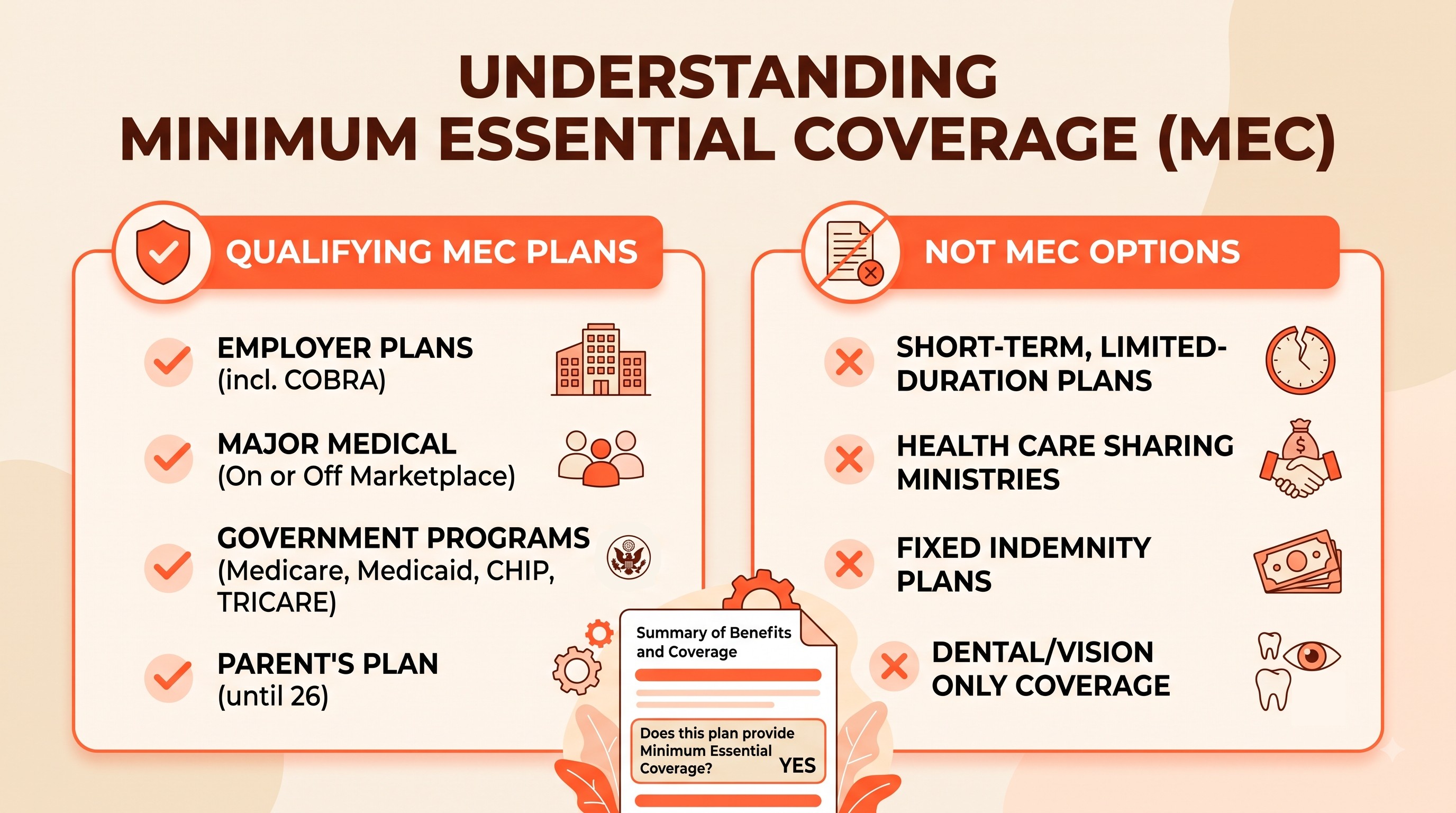
- Employer-sponsored plans, including COBRA and retiree coverage.
- Individual major medical plans, whether bought on the ACA marketplace or off-marketplace, as long as the plan qualifies. This is the category Molli falls in: Molli is an ACA-compliant major medical plan, and its plan documents state that it provides minimum essential coverage and meets minimum value standards.
- Government programs: Medicare Part A, Medicaid (most categories), CHIP, TRICARE, and most VA coverage.
- A parent's plan you are on until age 26.
Note what that second bullet means: a plan does not have to be sold on HealthCare.gov to be minimum essential coverage. Where a plan is sold is a distribution channel; MEC status is about what the plan is.
What does NOT count as MEC
This is the list that protects you. None of the following are minimum essential coverage:
- Short-term, limited-duration plans, no matter how comprehensive the marketing sounds.
- Health care sharing ministries and healthshares (including newer crowdfunded models). Payment is not guaranteed and they are not insurance.
- Fixed indemnity plans that pay set cash amounts per incident.
- Dental-only or vision-only coverage.
- Discount cards, telehealth-only memberships, and accident supplements.
These products can have a place as supplements, but if one of them is your primary coverage, you are legally uninsured, with everything that implies for pre-existing conditions, caps, and cancellations.
Why MEC still matters in 2026
1. State penalties are real. The federal penalty for lacking MEC dropped to $0 in 2019, but several states run their own mandates: California, Massachusetts, New Jersey, Rhode Island, and Vermont have coverage requirements (most with tax penalties), and Washington, D.C. does too. In California, for example, going uninsured can cost a family well over $2,000 at tax time.
2. It is the fastest junk-plan filter that exists. One question, "is this plan minimum essential coverage?", instantly separates major medical insurance from short-term plans, healthshares, and indemnity products. Sellers of non-MEC products are required to disclose it, but the disclosure often lives in fine print. Ask directly.
3. Proof-of-coverage requests. Employers, lenders, visa sponsors, and some state agencies ask for evidence of qualifying health coverage. MEC status is what they are asking about, and it is documented on the tax forms (1095 series) that real coverage generates.
4. Special enrollment rights. Losing MEC is a qualifying life event that opens a special enrollment period on the marketplace. Losing a non-MEC product (a healthshare, a short-term plan) is not. If your healthshare drops you, you may be stuck waiting for open enrollment; if you leave a MEC plan, you have a 60-day window to enroll elsewhere.
How to check any plan in 30 seconds
Open the plan's Summary of Benefits and Coverage (SBC), a standardized document every real health plan must publish, and look near the end for two lines:
Does this plan provide Minimum Essential Coverage? Yes
Does this plan meet the Minimum Value Standards? Yes
Two yeses mean you are looking at real major medical coverage. If a seller cannot produce an SBC at all, that is your answer.
Where Molli fits
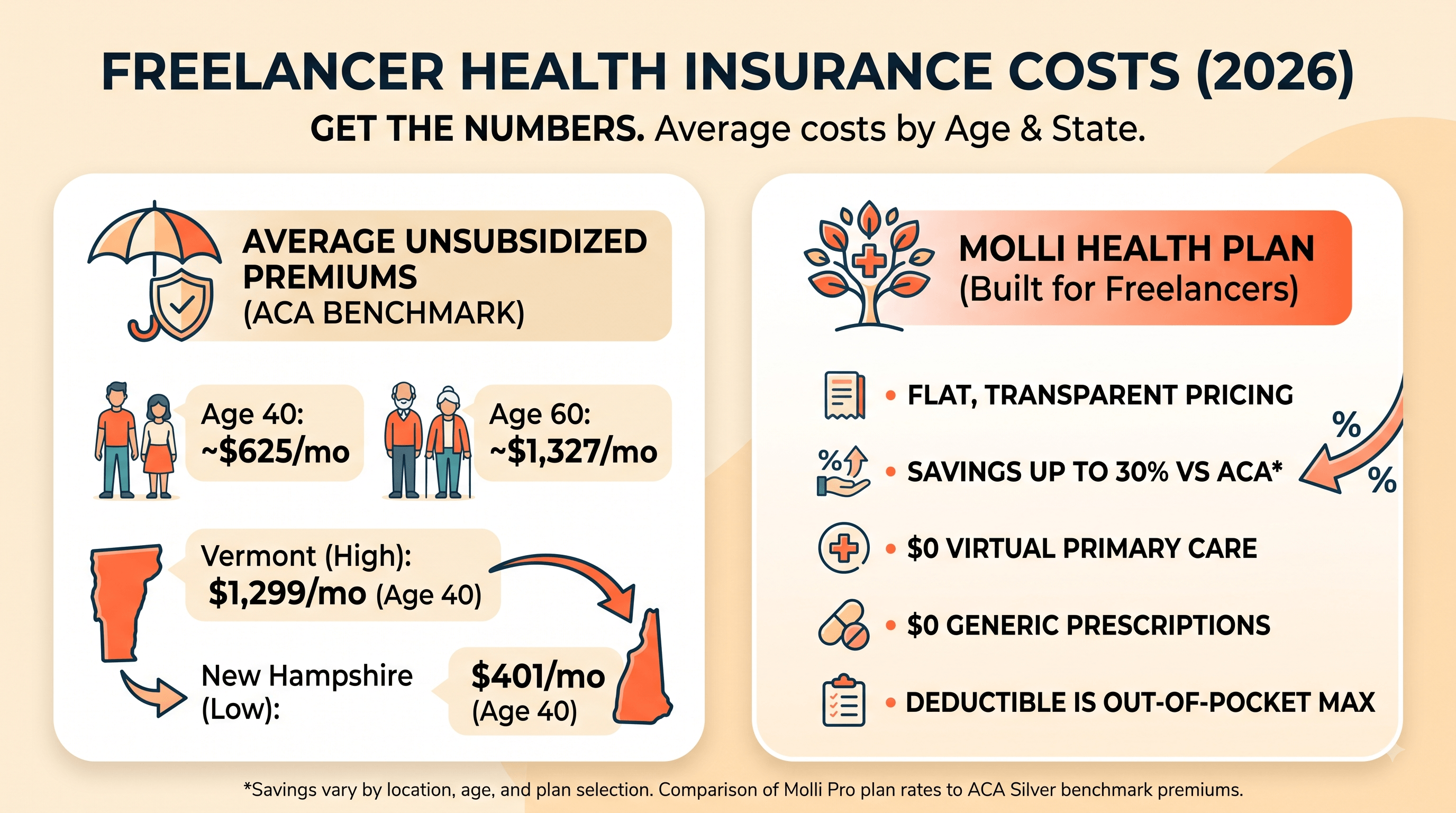
Molli is an ACA-compliant major medical plan built for freelancers, contractors, and 1099 workers, and it answers yes to both questions above: it provides minimum essential coverage and meets minimum value standards. It is sold off the marketplace, with flat, transparent pricing that can save up to 30% vs. ACA marketplace plans¹, $0 virtual primary care and $0 generic prescriptions through Vitable, preventive care covered 100% before the deductible, and year-round enrollment.
If you are comparing Molli against a short-term plan or a healthshare on price, you are not comparing like with like: one is minimum essential coverage, the others are not. See how Molli's plans are built.
Frequently asked questions
What is minimum essential coverage in simple terms? It is the ACA's official list of what counts as real health coverage: employer plans, individual major medical plans (on or off the marketplace), Medicare, Medicaid, CHIP, and similar programs. Short-term plans, healthshares, and indemnity products are not on the list.
Is there still a penalty for not having minimum essential coverage? The federal penalty is $0, but California, Massachusetts, New Jersey, Rhode Island, Vermont, and Washington, D.C. have their own coverage requirements, most with state tax penalties.
Does a plan have to be on HealthCare.gov to count as minimum essential coverage? No. Individual major medical plans sold off the marketplace can qualify as MEC. Where a plan is sold is a distribution channel; MEC status is about the coverage itself.
How do I check if a plan is minimum essential coverage? Look at its Summary of Benefits and Coverage (SBC). Near the end it must state whether the plan provides minimum essential coverage and meets minimum value standards. If there is no SBC, it is not major medical insurance.
¹ Savings vary by location, age, and plan selection. Based on comparison of Molli Pro plan rates to ACA Silver benchmark premiums.