Stride Health Alternatives for Freelancers: An Honest 2026 Comparison
Stride Health Alternatives for Freelancers: An Honest Comparison (2026)
If you've freelanced for more than a few months, you've probably run into Stride Health. It's one of the most visible names in self-employed health coverage, but visibility isn't the same as fit. Depending on your income, how you actually use healthcare, and how your work is structured, another option might serve you better.
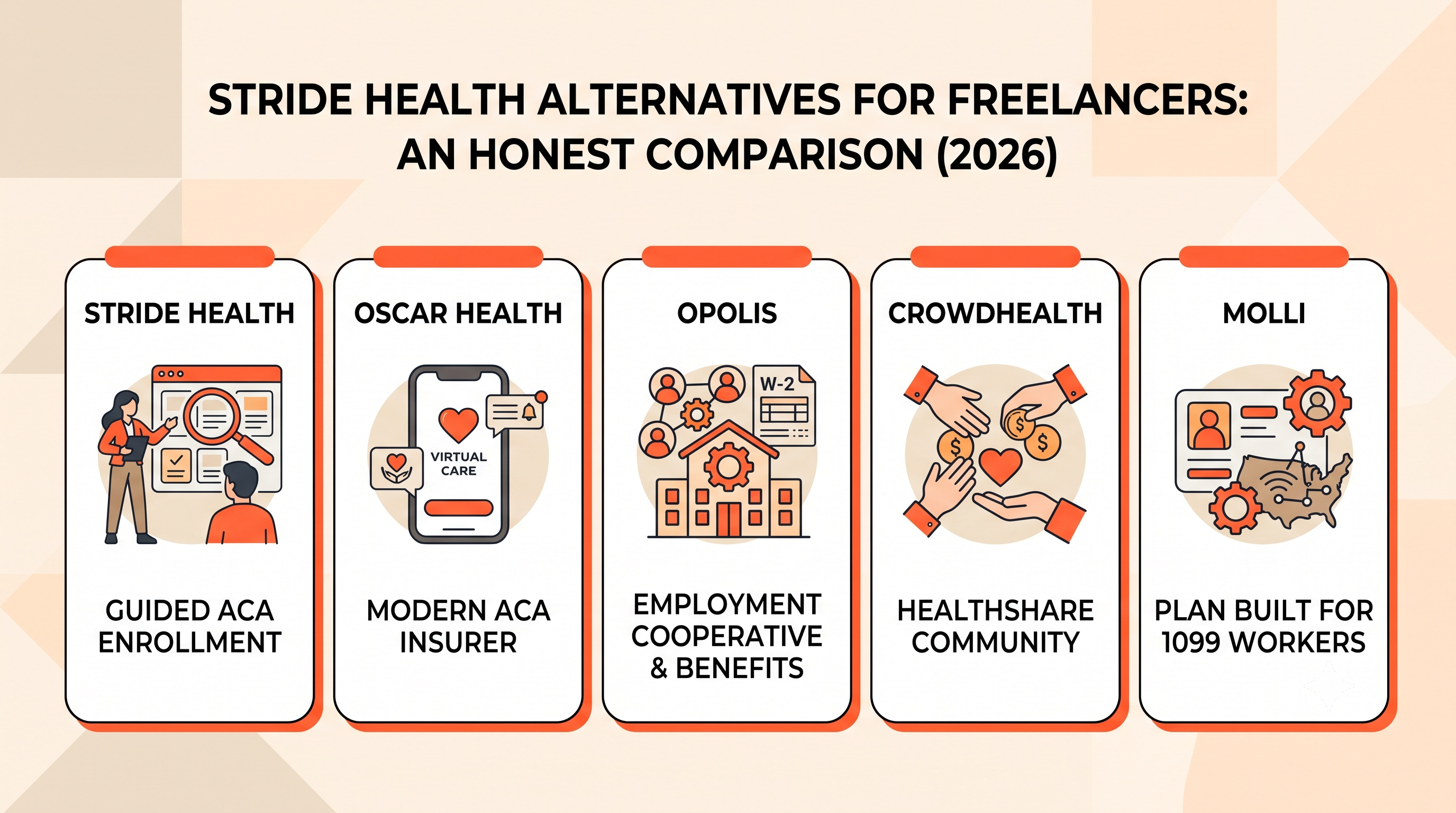
This is an honest look at five options available to freelancers and independent contractors in 2026: Stride Health, Oscar Health, Opolis, CrowdHealth, and Molli. Each has real strengths. Each has real trade-offs. The goal is to help you find the one that matches your situation, not to pretend a single answer fits everyone.
A quick map before we start. One of these (Stride) is a navigator that helps you enroll in ACA plans. One (Oscar) is a modern ACA insurer you buy directly. One (Opolis) is an employment cooperative that turns you into a W-2 member to unlock group benefits. One (CrowdHealth) is a healthshare, not insurance. And one (Molli) is a plan built specifically for 1099 workers. Knowing which category you're looking at is half the decision.
Stride Health: best for subsidy-eligible freelancers who want a guided ACA experience
Stride is a health insurance marketplace and broker. As an official HealthCare.gov partner, it offers the same ACA plans at the same prices as the marketplace, plus a selection of private plans, with tools built for self-employed people: income-based subsidy estimates, plan recommendations, and help through open enrollment. Stride also offers tax tools for 1099 workers.
Where it wins: it makes ACA shopping simple and is genuinely good at surfacing subsidies. Stride says most of its users qualify for financial help. If your income qualifies you for a premium tax credit, Stride can help you find a plan where that subsidy meaningfully lowers your monthly cost.
The trade-off: Stride doesn't offer its own insurance, it earns commissions connecting you to plans. That's a legitimate model, but its value is tied to the marketplace. If your income sits above the subsidy threshold, Stride can still help you compare, but you're paying full unsubsidized rates.
Best fit: freelancers who qualify for ACA subsidies and want guided help enrolling.
Oscar Health: best for freelancers who want a modern ACA insurer (and may qualify for subsidies)
Unlike a navigator, Oscar is an actual insurer, you buy an Oscar plan directly. It's known for a strong digital experience: an easy-to-use app, $0 virtual urgent care, low-cost generic prescriptions, and solid chronic-condition support. Oscar sells ACA-compliant individual and family plans across Bronze, Silver, Gold, and Platinum tiers.
Where it wins: a genuinely modern, app-first insurance experience at competitive marketplace prices, and because it's an ACA plan, subsidies and cost-sharing reductions can apply if you qualify.
The trade-off: availability is state-limited (Oscar operates in a subset of states as of 2026), many Oscar plans use an EPO network, which typically means no out-of-network coverage except emergencies, and, as a marketplace plan, you're generally tied to open enrollment.
Best fit: freelancers in an Oscar state who want a modern ACA insurer, may qualify for subsidies, and are comfortable with an EPO network.
Opolis: best for freelancers ready to operate through an entity to unlock group benefits
Opolis takes a fundamentally different approach. Instead of selling you an individual plan, it's a digital employment cooperative: you become a W-2 member of the cooperative, which then provides group health benefits along with payroll and tax handling. The idea is to give independent workers the kind of group-rate benefits that solo 1099 workers usually can't access on their own.
Where it wins: group-style benefits and back-office support (payroll, tax handling, benefits administration) bundled together, built specifically for independent workers.
The trade-off: the commitment is real. To get the full benefits you generally need to form an S-corp or C-corp (Opolis will help set one up), buy a membership share, and meet a minimum earnings threshold, you're changing how you're employed and taxed, not just buying a plan. For someone juggling multiple clients or who simply wants coverage without restructuring their business, that's a lot of overhead.
Best fit: established, higher-earning freelancers willing to adopt a W-2/cooperative structure to access group benefits.
CrowdHealth: best for healthy freelancers comfortable with a non-insurance model
CrowdHealth is not insurance. It's a healthshare community that uses crowdfunding: you pay a monthly membership (roughly $60), pay cash prices for care, submit your bills, and the community helps fund eligible expenses above your share.
Where it wins: for healthy people who rarely need care, the monthly cost can be low, and members like the transparency of the cash-pay model and the bill-negotiation help.
The trade-off: because it isn't insurance, payment isn't guaranteed, if a bill isn't fully funded, you can be responsible for the remainder. Pre-existing conditions are generally excluded in the early years of membership, and there's no provider network, you're negotiating cash prices.
Best fit: healthy, risk-tolerant freelancers who want the lowest monthly cost and are comfortable operating outside the insurance system.
Molli: best for freelancers who want a plan built specifically for 1099 workers
Molli is the newest option here, and it's built differently from everything above. Rather than brokering ACA plans (Stride), selling a state-limited marketplace plan (Oscar), wrapping you in a W-2 structure (Opolis), or operating outside insurance (CrowdHealth), Molli offers its own ACA-compliant major medical plan designed specifically for freelancers, contractors, and 1099 workers, with no entity to form and no change to how you work.
A few things stand out about how it's structured:
- The network. Molli gives you nationwide PPO access to major health systems like Johns Hopkins, Mount Sinai, UCLA Health, and Stanford Medicine. You get broad, national access with the out-of-network flexibility a PPO provides.
- Everyday care is built in. Virtual primary care and generic prescriptions are $0 through Vitable, Molli's bundled virtual-care benefit, so routine visits and generic refills are free from day one, not costs you carry until you hit a deductible. Preventive care is covered 100% before your deductible.
- Portability. Your coverage follows you whether your work status is 1099 or W-2. Pick up a short-term contract that classifies you as W-2? Your plan doesn't change.
- Enrollment. Year-round. No open-enrollment window, no qualifying life event required.
- Transparent pricing. Flat pricing with no hidden fees, save up to 30% vs. ACA marketplace plans¹; see plan options in the calculator at mollihealth.com/health-plan.
The honest trade-off: if you qualify for meaningful ACA subsidies, a marketplace plan via Stride or directly from Oscar may bring your premium down further. Molli is strongest for freelancers paying full, unsubsidized premiums who want a broad national PPO with everyday care built in, without restructuring their business to get it.
Best fit: 1099 workers who want a purpose-built plan with broad PPO access, bundled $0 everyday care, portability, and year-round enrollment.
How to choose
Start with your income. If you qualify for ACA subsidies, a marketplace plan, through Stride or directly from Oscar, may get you to a competitive monthly premium. Run the real numbers before assuming the marketplace is too expensive.
If you're above the subsidy threshold, the math shifts. You're paying full price on the marketplace, and a plan built for your situation starts to look a lot more competitive.
Think about your work structure. If you're ready to run your income through an entity and become a W-2 member, Opolis can unlock group benefits, but it's a real commitment. If you'd rather not restructure your business, a direct plan like Molli avoids that overhead entirely.
Think about how you use healthcare, and your appetite for risk. If you almost never see a doctor and can tolerate risk, a healthshare like CrowdHealth can be low-cost, just understand it isn't insurance and doesn't guarantee payment. If you use primary care or fill prescriptions regularly, Molli's bundled $0 everyday care changes your real cost meaningfully.
Check the network. If broad, national, out-of-network flexibility matters, a PPO (like Molli's) behaves differently from an EPO (common with Oscar), and a healthshare has no network at all. Confirm your doctors work with whatever you choose.
No single option is right for everyone. But the right one for you is out there, and now you have enough to make a real comparison.
See your Molli plan options, Calculate Your Plan at mollihealth.com/health-plan.
Frequently asked questions
Is Stride Health free to use? Yes. Stride earns commissions when you enroll through its platform, so there's no direct cost to you for using its comparison and enrollment tools.
Does Oscar cover me everywhere? Not necessarily. Oscar sells plans in a subset of states, and many of its plans use an EPO network, which typically doesn't cover out-of-network care except in emergencies. Check availability and the network in your area.
What does it mean that Opolis uses a W-2 model? Opolis is an employment cooperative. Rather than selling you an individual plan, it employs you as a W-2 member of the cooperative, which unlocks group benefits. To access the full benefits you generally need to form an S-corp or C-corp and meet a minimum earnings threshold, so it changes how your income is paid and taxed, not just your insurance.
Is CrowdHealth health insurance? No. CrowdHealth is a healthshare, a community where members share each other's medical costs through crowdfunding. It isn't insurance, payment isn't legally guaranteed, and pre-existing conditions are generally limited in the early membership period.
Does Molli require open enrollment? No. Molli offers year-round enrollment, so you can start a plan when you need it, no enrollment window and no qualifying life event required.
Are Molli's virtual care and generic prescriptions really $0? Yes. Virtual primary care and generic prescriptions are $0 through Vitable, Molli's bundled virtual-care benefit, and preventive care is covered 100% before your deductible. Other costs depend on the specific plan you choose, see the plan calculator.
What providers are in Molli's network? Molli gives you nationwide PPO access to major health systems like Johns Hopkins, Mount Sinai, UCLA Health, and Stanford Medicine.
¹ Savings vary by location, age, and plan selection. Based on comparison of Molli Pro plan rates to ACA Silver benchmark premiums.