Why Some Health Plans Are Not on Healthcare.gov
Why Some Health Plans Aren't Sold on HealthCare.gov
Most people assume HealthCare.gov is health insurance: if a plan is not listed there, something must be wrong with it. That assumption is understandable, and wrong. HealthCare.gov is a store, one sales channel among several, and some legitimate, ACA-compliant major medical plans are sold outside it on purpose. Here is how the market actually works.
What HealthCare.gov actually is
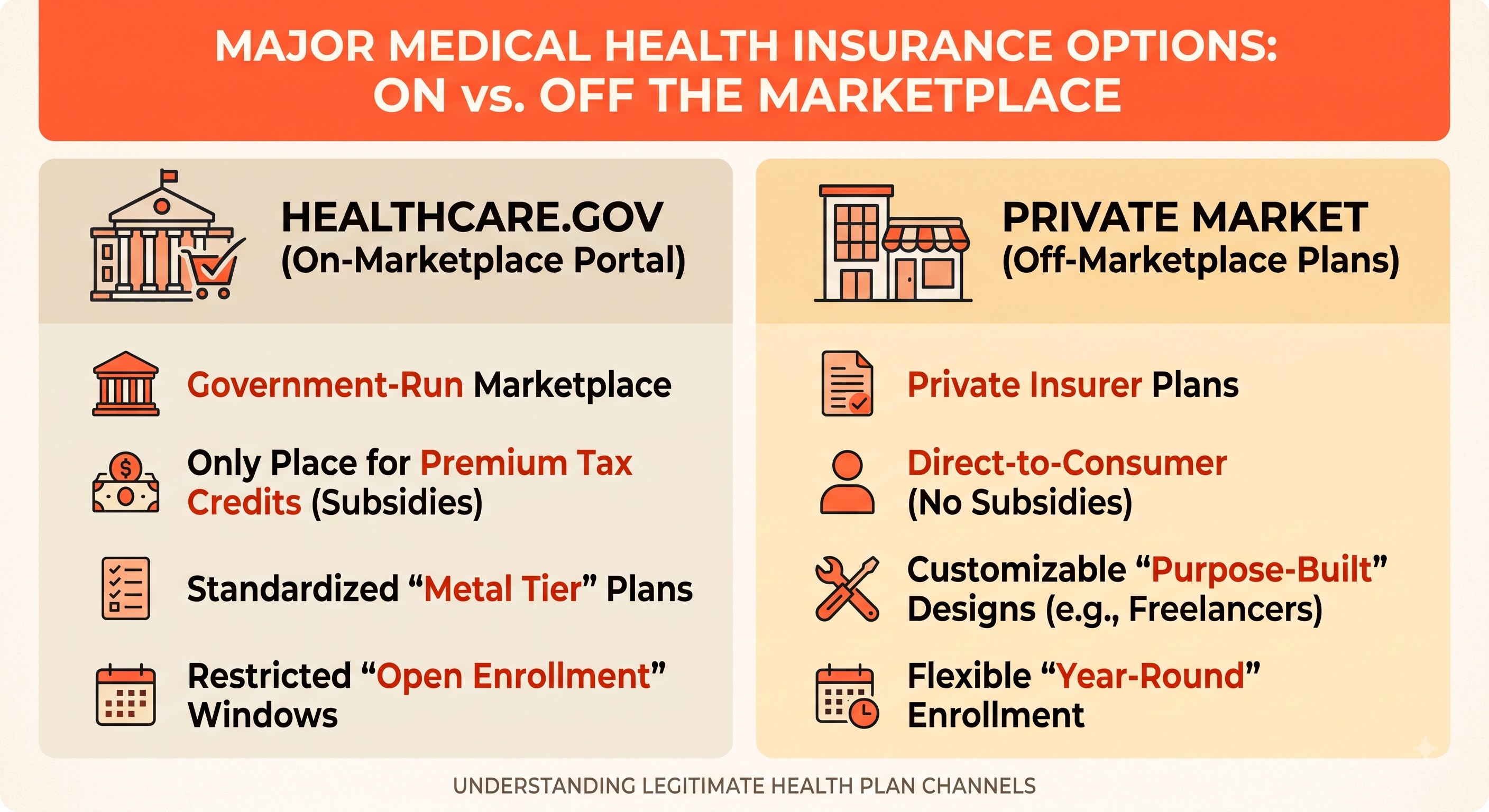
HealthCare.gov (and the state exchanges like Covered California) is the government-run marketplace: a shopping portal where insurers can list qualified health plans, and the only place the ACA's premium tax credits can be applied. That last part is the marketplace's real superpower. If you qualify for a subsidy, you must buy there to get it.
But listing on the marketplace is a choice insurers make plan by plan, not a requirement for being real insurance. The same laws that define major medical coverage apply on and off the exchange.
Why a legitimate plan would sell off-marketplace
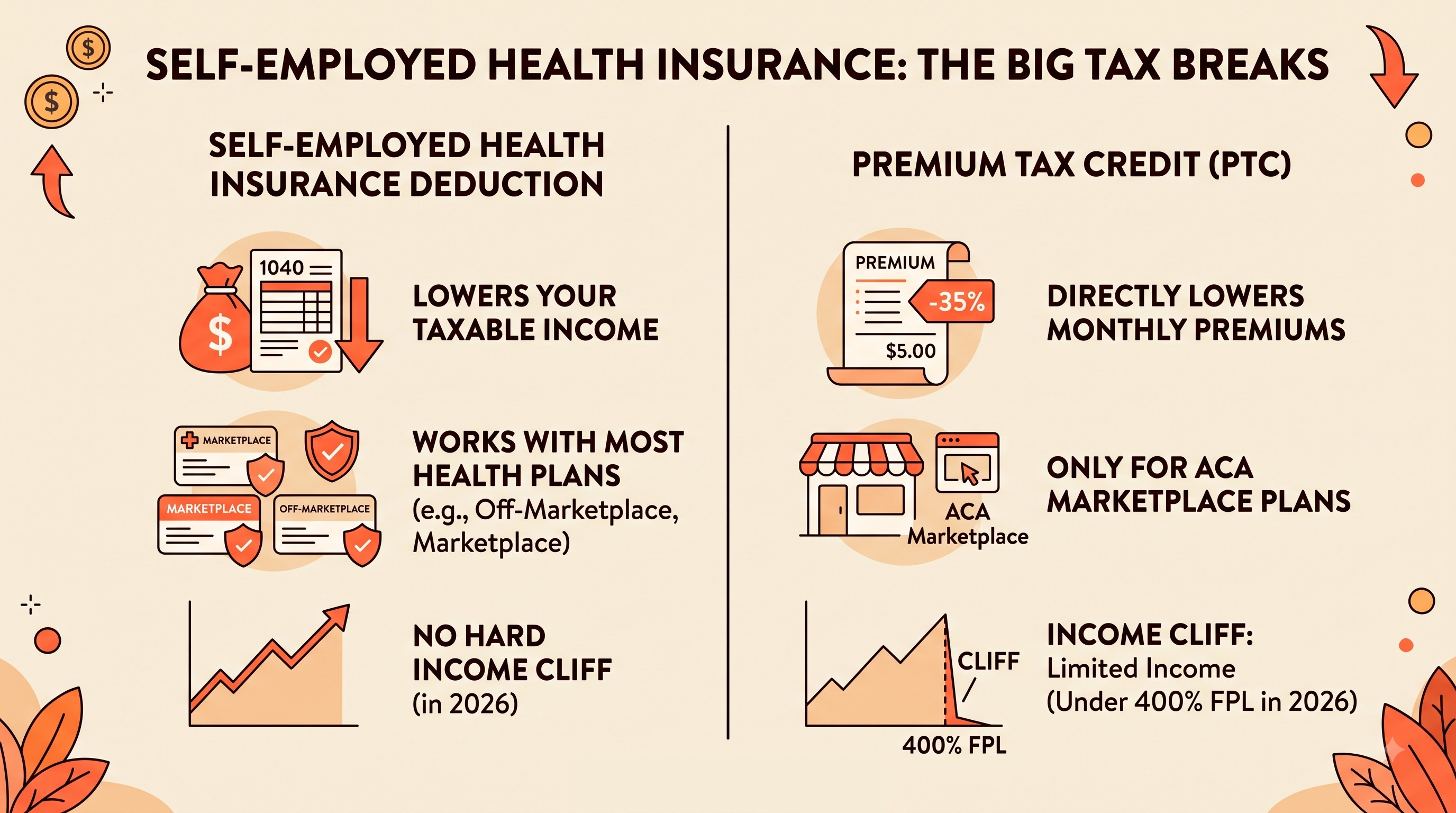
1. Its buyers do not get subsidies anyway. Marketplace listing matters most for subsidized buyers. In 2026 the enhanced credits are gone and the 400% of poverty income cliff is back (about $62,600 for a single person), so a large share of self-employed buyers get no subsidy at all. A plan built for those buyers gains little from the exchange and can skip its constraints. We broke down the mechanics in our subsidy cliff explainer.
2. Different plan design for a specific audience. Marketplace plans are standardized around metal tiers and county-by-county filings. Off-marketplace, an insurer can design for one audience instead of every audience: for example, a plan built specifically for 1099 workers with flat national pricing, a simplified deductible structure, or bundled benefits like $0 virtual primary care.
3. Enrollment flexibility. Marketplace plans can only be sold during open enrollment (November 1 to December 15 in most states) or after a qualifying life event. Some off-marketplace plans enroll year-round, which matters when your coverage need does not arrive on the government's calendar, a common situation for freelancers whose work status changes mid-year.
4. Simpler pricing. On-marketplace pricing is built around the subsidy system: estimate your income, get a credit, reconcile at tax time. Off-marketplace plans can quote one flat price with no income guesswork and no risk of paying subsidies back.
The honest trade-off
Off-marketplace has one structural downside, and it is a big one for some buyers: premium tax credits never apply there. If your income qualifies you for a meaningful subsidy, a marketplace plan is very likely your best deal, and you should buy on the exchange. Off-marketplace plans compete for everyone else, especially buyers above the subsidy cliff who pay full sticker price either way.
The caution: off-marketplace is also where junk lives
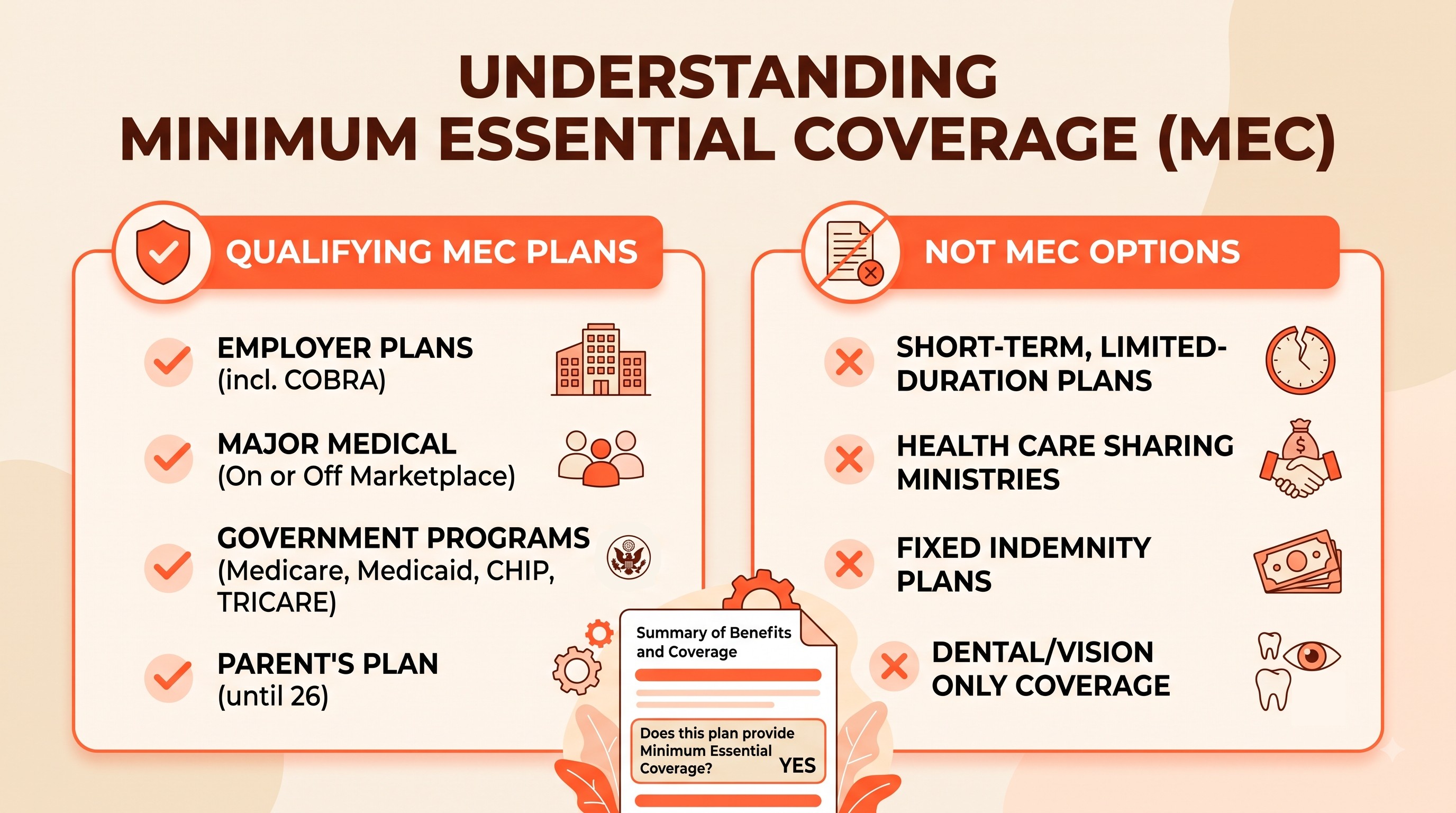
Everything above describes legitimate off-marketplace major medical plans. But the off-marketplace world also contains short-term plans, healthshares, and fixed indemnity products that are not real health insurance. The filter is simple and takes 30 seconds: ask whether the plan is minimum essential coverage, and check its Summary of Benefits and Coverage (SBC) for the "Minimum Essential Coverage: Yes" line. We wrote a full guide: What is minimum essential coverage and why it matters.
A quick vetting checklist for any off-marketplace plan:
- Is it minimum essential coverage (stated in the SBC)?
- Is it major medical with an out-of-pocket maximum, not a fixed cash payout?
- Are pre-existing conditions covered?
- Is preventive care covered at 100%?
- Is there a real provider network you can search?
Five yeses means you are comparing a legitimate plan on its merits. Any no means you are looking at a different product category.
Where Molli fits
Molli is exactly this category done right: an ACA-compliant major medical plan that provides minimum essential coverage, sold off the marketplace by design because it is built for freelancers, contractors, and 1099 workers, the buyers the subsidy system now largely leaves out. That design choice is what enables flat, transparent pricing that can save up to 30% vs. ACA marketplace plans¹, a simple structure where your in-network deductible is also your out-of-pocket maximum (the plan pays 100% after you meet it), $0 virtual primary care and $0 generic prescriptions through Vitable, nationwide PPO network access, and year-round enrollment with no qualifying life event required.
Run the checklist above on Molli and you get five yeses, with the SBC to back it up.
Frequently asked questions
Is a health plan legitimate if it's not on HealthCare.gov? It can be. HealthCare.gov is a sales channel, not a certification. ACA-compliant major medical plans are also sold off-marketplace. The check that matters is whether the plan provides minimum essential coverage, which its Summary of Benefits and Coverage must state.
Why would an insurer sell a plan off the marketplace? Usually because its target buyers do not qualify for subsidies, which only exist on-marketplace. Selling off-exchange also allows purpose-built plan design, flat pricing without subsidy reconciliation, and year-round enrollment instead of a fixed window.
What do you give up by buying off-marketplace? Premium tax credits, which apply only to marketplace plans. If your income qualifies you for a meaningful subsidy in 2026 (under about $62,600 for a single person), a marketplace plan is likely your best value. Above that line there is no subsidy either way.
How do I avoid junk insurance when shopping off-marketplace? Ask one question: is it minimum essential coverage? Real major medical plans state "Minimum Essential Coverage: Yes" in their Summary of Benefits and Coverage. Short-term plans, healthshares, and fixed indemnity products cannot.
¹ Savings vary by location, age, and plan selection. Based on comparison of Molli Pro plan rates to ACA Silver benchmark premiums.